


Mollusks, STEM, and the Fibonacci Sequence in the Florida Keys

Establishing meaningful connections between mathematical concepts and real-world marine ecosystems represents one of the most powerful approaches to STEM education. The Florida Keys provide an unparalleled natural laboratory where students can discover the remarkable intersection of marine biology and mathematics through the study of mollusks and their intricate shell patterns.
Understanding the prevalence of the Fibonacci sequence in mollusk shells offers educators a unique opportunity to demonstrate how mathematical principles govern natural systems, creating unforgettable learning experiences that bridge abstract concepts with tangible marine life.
The Mathematical Foundation of Mollusk Architecture
Gastropods, the largest class of mollusks characterized by their single, spirally coiled shells, showcase nature's adherence to mathematical precision. The Fibonacci sequence: where each number equals the sum of the two preceding numbers (1, 1, 2, 3, 5, 8, 13...): manifests directly in the spiral architecture of these marine creatures.
Observe how gastropod shells demonstrate this pattern through their growth chambers. Each successive chamber grows at distances governed by the golden ratio (Phi), creating spirals that appear throughout over 50,000 species of mollusks. This mathematical relationship, first identified in the thirteenth century, reveals itself consistently across diverse gastropod species found throughout the Florida Keys' shallow waters.

The spiral design serves critical functional purposes beyond aesthetic appeal. The coiled architecture provides structural integrity while maximizing interior space efficiency. For chambered species like the nautilus, these mathematically precise chambers function as sophisticated flotation devices filled with gas, enabling effortless hovering in the water column and exponentially more efficient feeding compared to bottom-dwelling relatives.
Hands-On Discovery Through Marine Science Expeditions
Transform abstract mathematical concepts into concrete learning experiences by engaging students in systematic mollusk collection and analysis activities. The Florida Keys' abundant seagrass beds provide exceptional opportunities for students to discover mathematical patterns through direct observation and measurement.
Implement structured scavenger hunt activities where students:
Collect gastropod specimens from guided net pulls in designated seagrass areas
Count and record spiral patterns in collected shells
Measure shell dimensions to calculate ratios
Document species diversity and mathematical consistency across different gastropod families
Compare findings with Fibonacci number sequences
Analyze functional advantages of spiral architecture
These hands-on learning trips extend discovery beyond gastropods to encompass similar spiral patterns in sea horse tails, fern fronds, and other marine organisms, reinforcing that mathematical order permeates natural ecosystems.
The Seagrass Ecosystem: A Mathematical Laboratory
Seagrass beds in the Florida Keys serve as crucial nursery habitats supporting remarkable species diversity, including numerous gastropod species that demonstrate Fibonacci patterns. These underwater meadows provide ideal conditions for student research activities while offering protection for developing marine life.
Recognize that seagrass ecosystems function as natural classrooms where students can observe:
Mathematical patterns in shell growth and development
Relationships between form and function in marine organisms
Ecological connections between mathematics and survival strategies
Species adaptation mechanisms governed by geometric principles
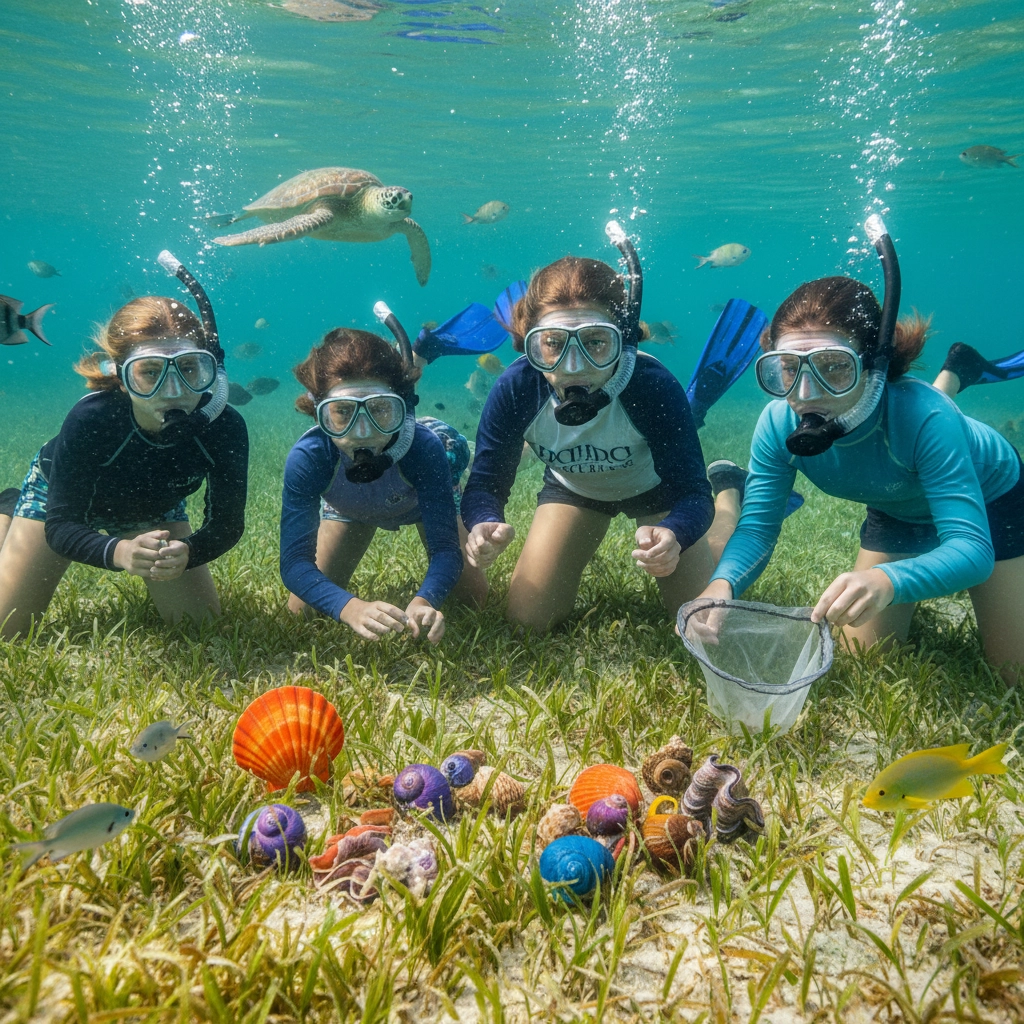
The protected nature of seagrass beds allows for safe, supervised student activities while ensuring minimal environmental impact. Students gain appreciation for both mathematical concepts and marine conservation through structured observation and data collection protocols.
Addressing Fundamental Questions About Natural Design
Encourage students to contemplate profound questions that emerge from observing consistent mathematical patterns in marine life. The universal appearance of the Fibonacci spiral across diverse gastropod species suggests fundamental principles governing natural systems.
Consider how mathematical formulas represent discoveries rather than human inventions: patterns that existed millions of years before humans evolved. The universe appears inherently mathematical, with organisms following geometric arrangements that maximize efficiency and survival advantages.
Guide students through critical thinking exercises that explore:
Why certain geometric patterns appear consistently across unrelated species
How mathematical relationships influence evolutionary success
Whether underlying forces favor specific architectural arrangements
The relationship between mathematical order and biological function
These discussions foster deeper understanding of both mathematical concepts and natural selection principles while developing analytical thinking skills essential for STEM disciplines.
Practical Implementation for Middle School Science Trips
Structure your school science trip to the Florida Keys around systematic investigation protocols that maximize learning outcomes while ensuring student safety and environmental protection. Begin preparation months in advance to establish clear learning objectives and safety procedures.
Implement the following structured approach:
Pre-trip preparation: Review Fibonacci sequences, gastropod anatomy, and seagrass ecosystem functions in classroom settings
Field data collection: Conduct supervised specimen collection using established protocols
Measurement and analysis: Guide students through systematic measurement and ratio calculations
Pattern documentation: Photograph and record mathematical relationships observed in collected specimens
Comparative analysis: Compare findings across different species and habitat zones
Synthesis activities: Connect mathematical discoveries to broader ecological principles

Ensure all activities comply with local regulations and environmental protection guidelines. Coordinate with experienced marine educators who understand both mathematical concepts and marine ecosystem dynamics.
The Broader Implications for STEM Education
Recognize that mollusk shell mathematics represents just one example of how natural systems demonstrate mathematical principles. Students who discover these patterns firsthand develop deeper appreciation for both mathematics and marine science, often leading to increased interest in STEM career paths.
Mathematical patterns in nature extend throughout marine ecosystems, from sunflower arrangements that optimize photosynthesis to pinecone seed distributions that maximize reproductive success. These universal principles demonstrate that mathematics governs life processes at fundamental levels.
Emphasize how organisms that follow mathematical patterns gain significant advantages:
Structural efficiency maximizing strength while minimizing material usage
Optimal space utilization within confined shell dimensions
Enhanced functionality supporting critical life processes
Evolutionary advantages promoting species survival and reproduction
Conservation Connections and Environmental Stewardship
Connect mathematical discoveries to conservation awareness by highlighting how human activities impact the delicate ecosystems supporting gastropod populations. The Florida Keys represent one of the most extensively studied coastal regions, yet comprehensive understanding of marine molluscan biodiversity remains incomplete.
Engage students in ongoing research projects that contribute to scientific knowledge while reinforcing mathematical concepts. Current biodiversity surveys in the Florida Keys provide frameworks for student participation in meaningful scientific research.

Address how environmental pressures affect mathematical precision in shell development. Climate change, water quality degradation, and habitat loss can disrupt the biological processes that create these remarkable mathematical patterns.
Measuring Success and Learning Outcomes
Evaluate student learning through multiple assessment approaches that demonstrate both mathematical understanding and marine science comprehension. Successful programs show measurable improvements in:
Mathematical pattern recognition and analysis skills
Understanding of geometric relationships in biological systems
Appreciation for marine ecosystem complexity and interconnectedness
Interest in pursuing advanced STEM coursework and careers
Environmental awareness and conservation commitment
Document student discoveries through digital portfolios that showcase mathematical calculations, specimen photographs, and analytical conclusions. These materials serve as powerful tools for sharing learning experiences with parents, administrators, and future student groups.
Ensuring Educational Excellence and Safety
Prioritize comprehensive preparation and risk management protocols to maximize educational outcomes while maintaining absolute commitment to student safety. Partner with experienced marine education providers who understand both mathematical concepts and marine environment safety requirements.
Implement detailed emergency procedures and maintain constant supervision ratios appropriate for marine environments. Ensure all participating students demonstrate swimming proficiency and understand marine safety protocols before beginning field activities.
The intersection of mathematics and marine biology in the Florida Keys offers unparalleled opportunities for transformative STEM education experiences. Students who discover Fibonacci patterns in gastropod shells develop lasting appreciation for both mathematical principles and marine conservation, carrying these insights throughout their academic and professional journeys.
Through systematic investigation of mollusk mathematics, educators create powerful connections between abstract concepts and tangible natural phenomena, inspiring the next generation of mathematicians, marine biologists, and environmental stewards.

Comments