


Q&A: What can students learn from Yellowstone's "Supervolcano"?

Yellowstone National Park is more than a scenic destination; it is a massive, active laboratory that offers unparalleled opportunities for students to engage with Earth Science, physics, and chemistry. At the heart of this landscape lies the Yellowstone Caldera, often referred to as a "supervolcano." Understanding the mechanics, history, and monitoring of this geological giant is essential for any student group visiting the region.
The following Q&A guide is designed to assist educators in framing the scientific significance of Yellowstone's volcanic system. By utilizing structured inquiry, teachers can help students move beyond the sensationalism of "supervolcano" headlines and into the rigorous world of geological data and predictive science.
Q: What specifically defines Yellowstone as a "Supervolcano"?
A: The term "supervolcano" is used by geologists to describe a volcanic center that has had at least one explosive eruption of a magnitude 8 on the Volcanic Explosivity Index (VEI). To provide context for students, a VEI 8 eruption releases more than 1,000 cubic kilometers (240 cubic miles) of material.
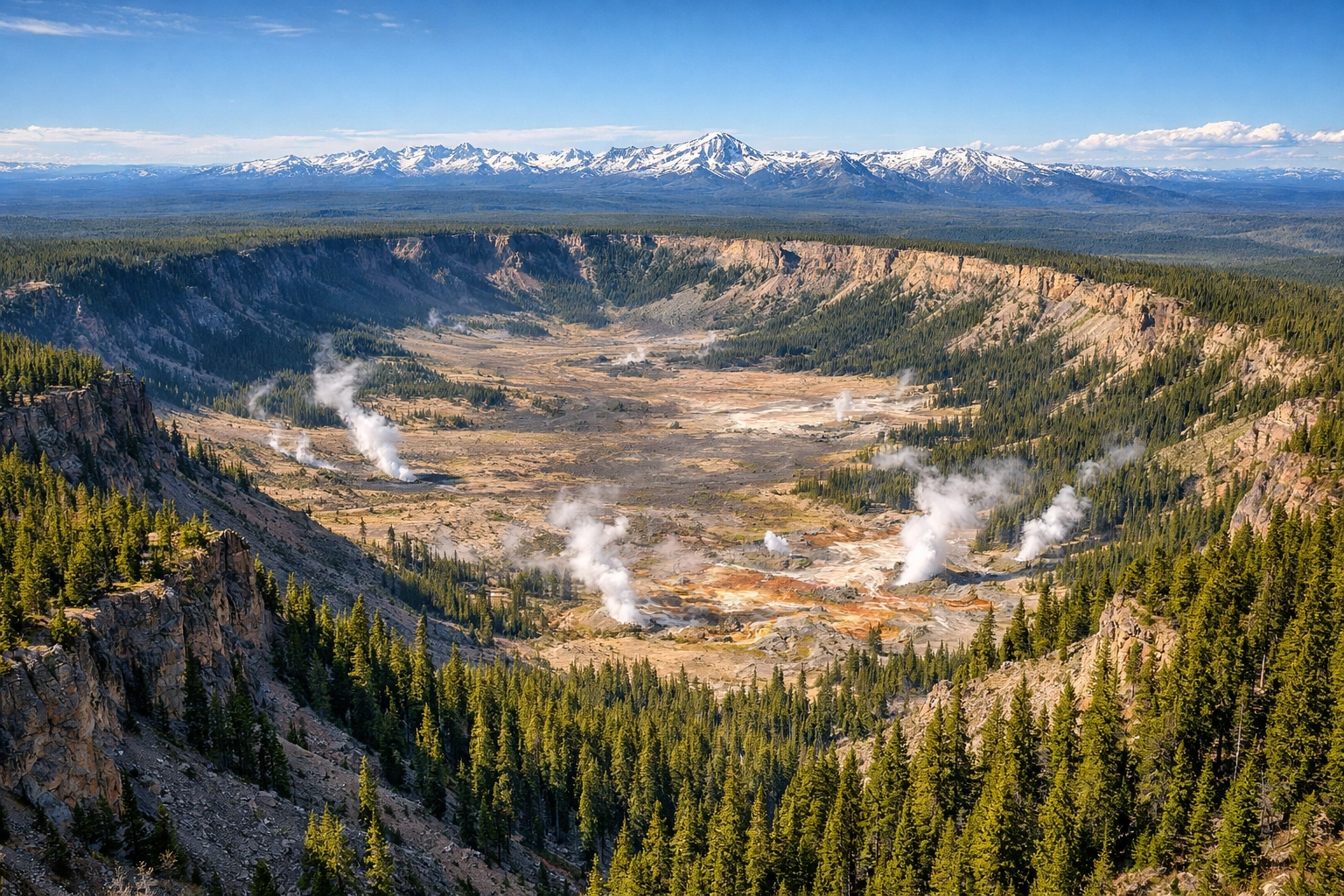
Unlike the iconic cone-shaped volcanoes like Mount Rainier or Mount St. Helens, Yellowstone is a caldera-system volcano. This means the eruptions were so massive that the ground surface collapsed into the partially emptied magma chamber, creating a giant depression in the earth. On an Appleseed Expeditions trip to North America, students can stand on the rim of this caldera and realize that the "mountain" they are looking for is actually the 30-by-45-mile basin beneath their feet.
Q: What can students learn from the history of Yellowstone’s major eruptions?
A: Students can study the concept of geological cycles by examining the three "big" eruptions that shaped the modern landscape:
The Huckleberry Ridge Eruption (2.1 million years ago): This was the largest of the three, creating a caldera that stretched across a massive portion of the region.
The Mesa Falls Eruption (1.3 million years ago): A smaller, yet still "super" eruption that demonstrated the ongoing activity of the hotspot.
The Lava Creek Eruption (640,000 years ago): This event created the current Yellowstone Caldera that we see today.
By analyzing these dates, students can practice mathematical modeling and pattern recognition. They learn that while these events are catastrophic, they occur over vast stretches of "deep time." This helps students conceptualize the difference between human history and geological history.
Q: How do scientists monitor the caldera today, and what can students learn from this data?
A: Monitoring a supervolcano requires a multi-disciplinary approach. The Yellowstone Volcano Observatory (YVO) utilizes a network of sophisticated instruments that provide real-world data sets for students to analyze:
Seismometers: These instruments detect "earthquake swarms." Students can learn that while thousands of small earthquakes happen in Yellowstone annually, they are usually the result of tectonic shifting or hydrothermal fluids moving, not necessarily magma rising.
GPS and InSAR: These technologies measure ground deformation. If the ground rises (uplift) or falls (subsidence), it indicates changes in pressure within the magmatic or hydrothermal systems. This introduces students to the precision of satellite-based earth science.
Gas Sensors: Scientists monitor the emission of volcanic gases like sulfur dioxide and carbon dioxide. Significant changes in gas composition can signal changes in the underlying magma body.
Educators should encourage students to view these tools as a "diagnostic kit" for the Earth, similar to how a doctor uses tools to monitor a patient’s health.
Q: What is the significance of "Trace Crystals" in volcanic research?
A: One of the most exciting recent developments in volcanology involves "petrology," or the study of rocks at a microscopic level. Researchers examine trace crystals (such as quartz or feldspar) found in fossilized ash from previous eruptions.
These crystals grow within the magma chamber and act like "flight recorders" or "black boxes." By analyzing the chemical layers within a single crystal, scientists can determine:
The temperature and pressure of the magma at different stages.
The water content of the system.
How quickly the magma moved before an eruption.
A key takeaway for students is that major geological processes can occur on surprisingly rapid timescales. Recent research suggests that magma can destabilize a volcanic system in decades rather than millennia. This challenges the traditional view of "slow" geology and emphasizes the importance of constant scientific vigilance.
Q: Is the Yellowstone Supervolcano "due" for an eruption?
A: This is the most common question students ask, and it provides a vital opportunity to teach scientific literacy and the debunking of myths.
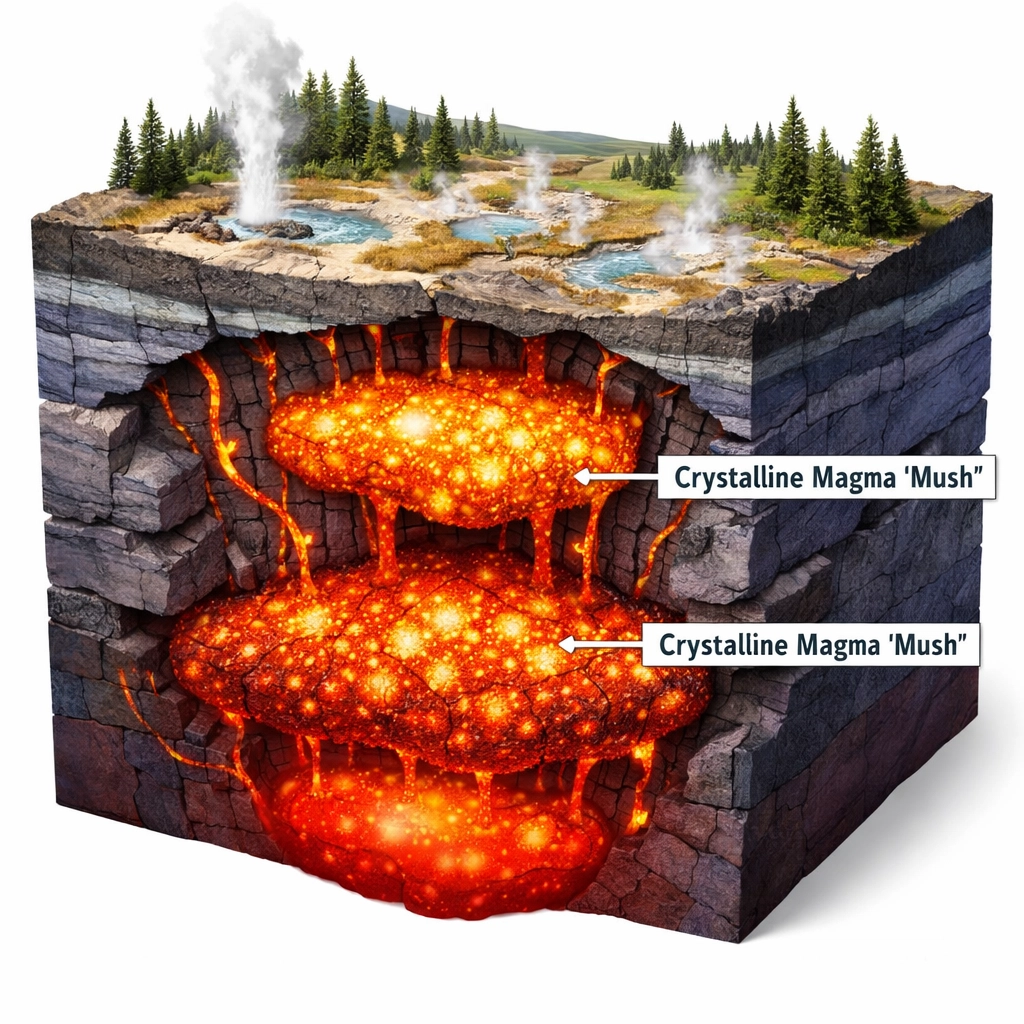
Statistically, volcanoes do not follow a predictable, clock-like schedule. Based on the intervals between the last three major eruptions, some media outlets claim we are "overdue." However, scientists at the YVO emphasize that the current data does not support this. In fact, most of the magma beneath Yellowstone is currently in a "mush" state: partially solid and not eruptible.
Current scientific consensus suggests that another supereruption is unlikely for another 1 to 2 million years. Educators should use this topic to teach students how to evaluate sources of information and rely on peer-reviewed data from organizations like the United States Geological Survey (USGS).
Q: How can Yellowstone’s heat be used for the future?
A: Beyond the hazards, the supervolcano offers a lesson in renewable energy and problem-solving. Scientists and engineers have proposed harnessing the immense geothermal heat generated by the magma chamber to produce clean energy.
This discussion allows students to bridge the gap between geology and environmental engineering. By understanding the "hazard" as a "resource," students learn to think innovatively about Earth’s natural processes. You can learn more about how we integrate these lessons into our itineraries by visiting our About page.
Q: Why is fieldwork essential for understanding these concepts?
A: Classroom learning provides the foundation, but fieldwork provides the context. When students see a steaming fumarole or a bubbling mud pot, they are witnessing the "exhaust" of the supervolcano.
At Appleseed Expeditions, we believe that experiencing the scale of the Grand Canyon of the Yellowstone or the geothermal intensity of the Norris Geyser Basin transforms abstract concepts into tangible reality. Our science-focused trips emphasize:
Safety and Supervision: We ensure students understand the volatile nature of hydrothermal areas, emphasizing the importance of staying on designated boardwalks.
Active Observation: Students are encouraged to use field journals to record observations of pH levels in pools or the temperature gradients of runoff channels.
Stewardship: By understanding the power and fragility of the Yellowstone system, students develop a deeper respect for national park conservation.
Preparing Your Students for a Yellowstone Expedition
Preparation is the cornerstone of a successful educational journey. To maximize the learning potential of a trip to Yellowstone, we recommend that educators take the following steps:
Establish a Scientific Baseline: Before departure, review the Volcanic Explosivity Index (VEI) and basic plate tectonics with your students.
Discuss Emergency Procedures: While the risk of an eruption is negligible, the hazards of hot springs and wildlife are real. Emphasize the importance of following park regulations and instructor guidance at all times.
Encourage Inquiry-Based Learning: Assign students specific "research roles" (e.g., Lead Seismologist, Geothermal Engineer, or Petrologist) to focus their observations during the trip.
For teachers looking to provide their students with a first-hand look at the "Supervolcano," Appleseed Expeditions offers specialized Yellowstone science trips that bring these Q&A topics to life. Our itineraries are meticulously planned to ensure student safety while maximizing educational impact.
Final Thoughts for Educators
The Yellowstone supervolcano is a gateway to complex scientific themes, from the microscopic analysis of crystals to the global impact of volcanic ash. By focusing on scientific monitoring and geological history, teachers can move students away from fear and toward a sophisticated understanding of how our planet functions.
Ensuring the safety of students while providing an inspiring educational environment is of paramount importance. Through careful preparation and a focus on evidence-based science, a trip to Yellowstone can be the defining academic experience of a student's life.
Ready to plan your next science expedition? Explore our teacher resources and trip options here.

Comments